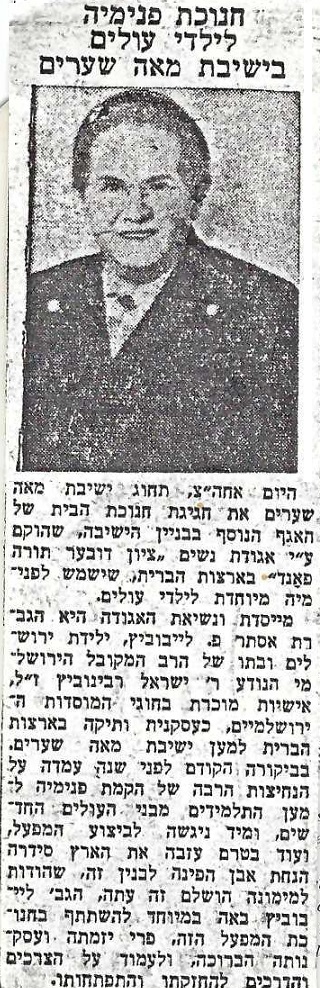
Esther Feigel Rabinowitz was born in the Old City of Jerusalem in March, 1896
to Golda Miriam Gottlieb and Yisroel (Israel) Rabinowitz (1870-1947).
Through her mother Golda's side Esther descended from a great Kabbalist, the great Maharsha, or Machshoy.
The Macshoy.
Esther Feigel Rabinowitz was born in the Old City of Jerusalem in March, 1896
to Golda Miriam Gottlieb and Yisroel (Israel) Rabinowitz (1870-1947).
Through her mother Golda's side Esther descended from a great Kabbalist, the great Maharsha, or Machshoy.
The Macshoy.
Esther Feigel was one of 11 children. There was a high infant mortality rate in Jerusalem at the time and 5 older siblings died as infants or young children, leaving her as the oldest child to survive.
Her mother, Goldie Gottlieb Rabinowitz owned a bakery in the Jewish Quarter of the Old City of Jerusalem. She would buy unpasteurized milk from Arab farmers, and the children got sick. By the time Esther Feigel was born, Golde stopped buying the milk that was causing all this sickness, or perhaps Esther survived because she had a stronger constitution than her older siblings who died.
Israel Rabinowitz, Esther's father, was a learned man who earned a small living from a yeshiva. He taught her to read and write Yiddish and Hebrew. She developed a deep interest in Jewish History and Talmud, including Midrash and Chumash and other sacred texts.
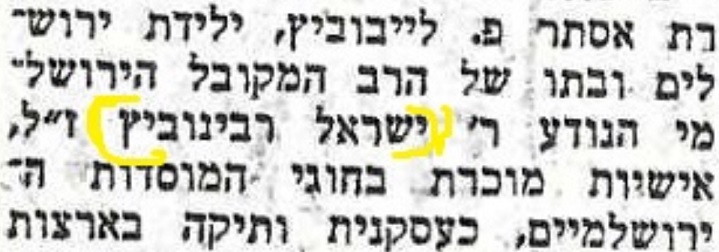
It translates something like -
"Esther Leibowitz is the daughter
s of the received / respected Rabbi Israel Rabinowitz of blessed memory,
who was a well known figure in the classes / programs
of Jerusalem institutions."
Israel Rabinowitz's mother Rivka or Rebecca (either Epstein or Rabinowitz)
Esther Leibowitz's grandmother
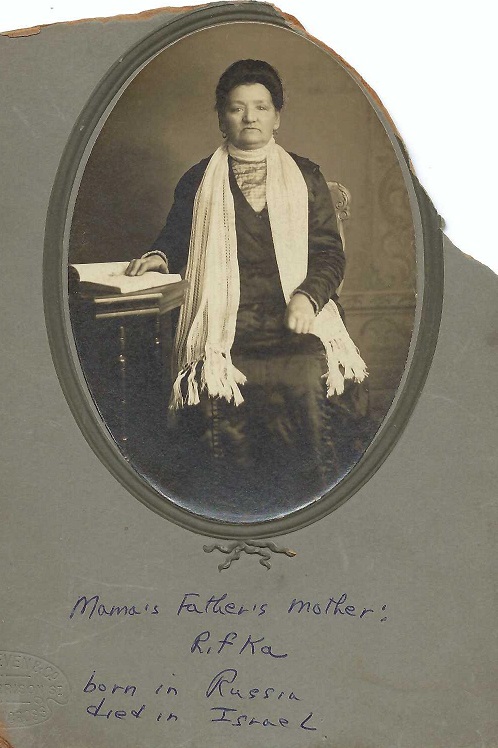
Rivka was born in Russia and died Israel.
Israel Rabinowitz (1870-1947) was the eldest son of Elchanan (or Elkan or Kona) and Rebecca. Elchanan was a Hebrew teacher.
Some conflicting info: It’s unclear whether Elchanan was a Rabinowitz or an Epstein. Rebecca was an Epstein and when her other children escaped from Russia, they used Epstein rather than Rabinowitz to escape detection.
Elchanan and Rebecca had 6 children:
 Israel Rabinowitz (1870-1947) - Esther Leibowitz's father
Joseph Epstein (Yoel Joseph Ben Elchanan) 1872-1952 (lived in Glasgow)
Philip Epstein 1874-1957 (a butcher in Manchester)
4. Jennie/Janie (Sheyna) Epstein 1878-1965 (went to Manchester)
she is the great grandma of Charmaine Gittleson who lives in Melbourne, Australia. Charmaine is the chief medical officer at a global pharma company and she and I met up a couple of times in the last few years when she was in London. She is a strong DNA match to me and has trees on Ancestry and MyHeritage. Her DNA match to me is 137cM and Barbara’s is 147cM
Jennie is the big sister referred to in my great-grandfather’s story attached. They all lived in Kochanov in modern day Belarus. You refer to her as your grandma’s aunt, yet I don’t think she ever went to Jerusalem. Or if she did she returned to Belarus. We do know that Robert’s eldest brother Israel went to Jerusalem, escaping from the Russian army. The other brothers escaped to Manchester and from there, to Glasgow. Quite how your Esther came to live in America I do not know; her sister Chaya stayed in Israel, but her sister Shayna (named after Israel’s sister) went to NY. Minnie went to New Jersey and Rafael I’m not sure, he died in NY I think. Back in the early 1900s, Israel was a difficult place to live in.
5. Solomon/Zalman Epstein (1882-1947) (Glasgow)
6. Robert (Yerachmiel) Epstein (1888-1987) – this is my (Daniel)
great grandfather whom I remember fondly.
A remarkably well and self-educated man
whose philanthropy in Glasgow is well known.
He had a department store in Glasgow called Roberts Stores.
a. Robert had two daughters, Mamie and Pauline. Pauline married Herbert Jaffe and had Pamela and David. My mother is Pamela Jaffe.
Robert's
autobiography)
Memorial about Esther Leibowitz's sister Shusha
sheds light on their childhood.
These are excerpts from a memorial that was written
about Esther Leibowitz's sister Shushe Zusman
after her passing in 1973.
Much of the details about Shusha's childhood generally
holds true for Esther Leibowitz.
I believe that this was probably written by Shusha's Kabbalist son,
Yosef Laab Zusman.
Memorial for the departed, Chaya Shusha Sussman (may she rest in peace).
As the daughter of Kabbalist Chasis, Rabbi Israel (Yisroel)
Rabinovitch (may the memory of the righteous be blessed),
she absorbed the foundations of Torah and awe.
Since the house was a gathering place for wise men,
who gathered to study the hidden secrets of the Torah,
she became enlightened with fragrance from the
spirit of the Torah and through an awakening from Above
she received an inspiration to the love of Torah.
Since those books that her father would deeply delve into
were sealed and incomprehensible for her,
she therefore satisfied her great thirst with the reading of books
that are specially prepared for Jewish women and are translated into Yiddish.
These are the stories of the Agadah and Tzina Penna, Menoras Mamoar,
and also books of thought and ethics: Rachis Chachmah, Shevet Mussar. She was diligent in studying these with great desire and a desire of love whenever she had time, and certainly she never missed reading the Yiddish translations of Ethics of the Fathers
because of the many stories and parables which were appended about them in the Korban Minsha
Siddur.
When she was still a young girl, she knew how to face up to the difficult conditions of life in her father house. Because of the dire straits in that house, she, together with her sister, Yalcheta, went to live with the grandfather, Reb Dov Ber HaLevi (of blessed memory). The aim of this step was twofold: first, to diminish the crowded condition of those who were dependent upon the father, and also to help out with something concrete for the income of the house.
Since the grandmother, Chanah (may she rest in peace), was the provider of the house, through the business of baking and selling of rolls and other baked goods, they joined her in her work and together they worked as bakers. Thus they were an important support for the needs of their father house, who occupied himself with the service of G-D.
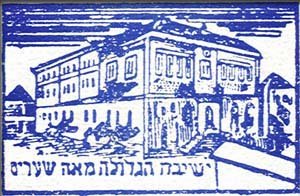
The Great Yeshiva Meah Shearim
Her brother David attended Yeshiva Meah Shearim, built in 1883. Esther Feigel had a very bright and active mind, hungry for knowledge, but she wasn't allowed to study in Yeshiva as only boys could, yet she still felt a connection to the Yeshiva and liked the atmosphere of learning and scholarship.
I think she used to sit in classes at the Yeshiva, or did she sneak in? Perhaps I'm getting mixed up with the movie "Yentl" lol?
As a child Esther shouldered great responsibilities in helping her family "live on starvation", as she stated it. She was old before her time - "I never went to play". While her mother took care of the infants, Esther was quick and efficient in taking care of her younger brothers and sisters. Yet she still went from house-to-house to collect money to help those poorer than herself. Like her father and grandfather before her she was always willing to help those more unfortunate than herself.
When Esther was 16 years old she was introduced to a very religious and handsome 19 year-old scholar named Itzchak (Isaac) Baruch Leibowitz, who taught in a Yeshiva. He was also descended from a great and learned family. His grandfather was an outstanding "Bal Shem" in Roumania. Born in Yasse (Iasi), Roumania, Isaac was brought by his aunt (or mother?) to Jerusalem when he was 2 years old.
Esther Feigel and Isaac Baruch married 6 months after they met. She described him as "beautiful", and herself as a "good looking goil".
My grandmother Esther Feigel loved Jerusalem and did not want to leave. She was afraid she might be forced to leave Jerusalem, but the young couple had no choice but to leave Jerusalem. Before she left, Esther Feigel made a lifetime pledge. She went to Yeshiva Meah Shearim and spoke with the founder of the Yeshiva, the Dubrovner Rav, Rabbi Chaim Shmuel Horowitz. He told her not to forget the Yeshiva and Jerusalem. She said of that meeting:
"The day I left Jerusalem I went to the Yeshiva to give a donation. The rabbi said to me 'Go my child, go. (I didn't want to leave Palestine). Wherever you live in the world, remember the Yeshiva'.""I did".
The following quote is from a souvenir journal given out at the banquet/anniversary dinner
Esther held every year to raise money through the
organization she started, The Zion Dov Ber Torah Fund for Yeshiva Meah Shearim
(see Baba's Organization). It quotes the rabbi saying to her:
"Don't be afraid to leave Israel, my child. But when you go out into the world, try to do whatever you can for the Meah Shearim Institutions. Remember that they are not charity institutions alone, but they are also great centers of Torah education. You will be enabling many families to send their children to study Torah without suffering hunger or the shame of wearing torn clothes. You will be helping Torah students to stand upright and proud. Do what you can!"
She did.
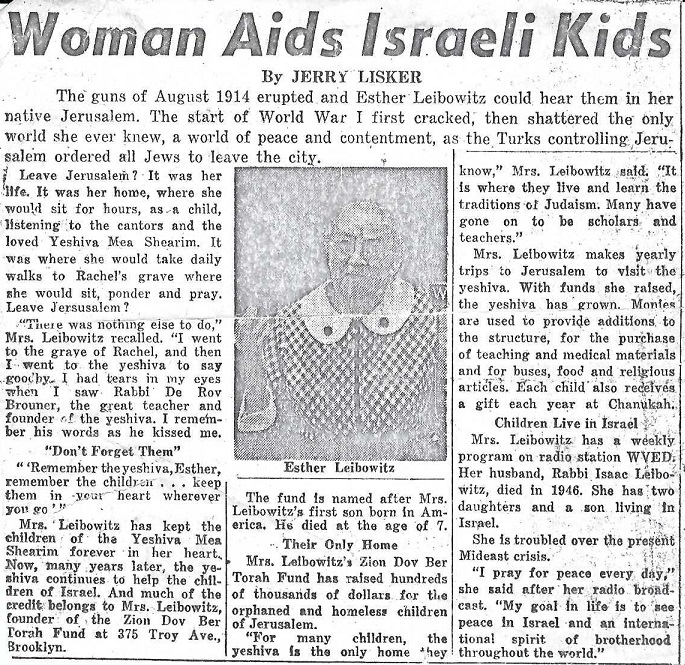
"Woman Aids Israeli Kids"
Article
excerpted below.
... Leave Jerusalem? It was her life. It was her home, where she would sit for hours, as a child, listening to the cantors and she loved Yeshiva Mea Shearim. It was where she would take daily walks to Rachel's grave where she would sit, ponder and pray. Leave Jerusalem?"There was nothing else to do," Mrs. Leibowitz recalled. I went to the grave of Rachel, and then I went to the yeshiva to say goodbye. I had tears in my eyes when I saw Rabbi De Rov Brouner, the great teacher and founder of the yeshiva. I remember his words as he kissed me. 'Remember the yeshiva, Esther, remember the children... keep them in your heart wherever you go.' "
Their first child Pearl was born in the transit camp. Like her mother, Pearl had "malaria and everything but money and what to eat". The Egyptian government gave bread, water and sugar and often accidentally bugs as food. I asked her, "How did you live", and she answered "When you have to live there, you live." Pearl was a talented pianist with a scholarship to the Julliard School of Music, when she died of pnuemonia at the age of 18.
They stayed in the transit camp in Egypt for a year until the war was over in November, 1918, at which time her uncle in America sent passage money. Isaac, Esther and Pearl traveled to America at a dangerous time when the German army would often sink ships. Pearl became very sick, nearly died, but survived.
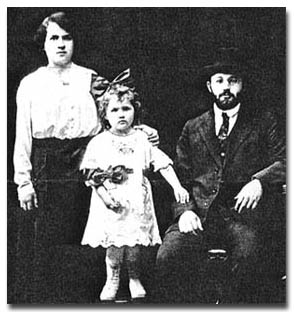
Upon arrival in America, they stayed at her uncle's and
then rented an apartment for $7.00 a month in Brooklyn.
They tried to eck out a living.
Back in Palestine, the British army invaded Palestine in June, 1919. Conditions were very harsh at this time. Palestine was a British Protectorate, under British control.
"My whole life I had a miserable life. I lost 4 children (ultimately 5 of her 6 children died before she did). Since I was 7 years, I help people. In the US when I didn't have what to eat, I helped others. I didn't have what to eat, I didn't take charity. What my uncle lent me I paid back."
She dedicated her life to Yeshiva Meah Shearim in Jerusalem.
She started the Zion Dov Ber Torah Fund after she arrived in New York
to raise funds for the Yeshiva. (Or was it after 2 sons died?)
Slowly she built up the Yeshiva
and then rebuilt it after the bombings in Jerusalem in 1949,
and through her organization's fund raising efforts
improvements were made such as a (new or improved) kitchen;
another floor; vans; and a new building.
Last modified May 2010.